
The visual allure of a miniature bamboo grove sitting pristine on a desktop is unmatched. Its clean lines, vibrant green canopy, and minimalist aesthetic evoke an immediate sense of calm and Zen-like order. Yet, for many indoor gardeners, this serene experience is abruptly cut short. Within three to four weeks of bringing their new plant home, they find themselves staring in frustration at a pot filled with brittle, straw-like sticks and dropped leaves.
The harsh reality is that true bonsai bamboo plant care operates on razor-thin margins of error. Unlike a forgiving pothos or a resilient snake plant, miniature bamboo cannot simply be watered on a casual whim or tucked away into a dark, forgotten corner of a room. It is a highly specialized botanical art form that requires a precise understanding of grass biology scaled down to a microscopic level.
To master this plant, we must first dismantle the single biggest misconception in the indoor gardening market: the confusion between true botanical bamboo and “Lucky Bamboo.” If your plant is growing out of a jar of plain water or features soft, fleshy stalks twisted into elaborate spirals, you are actually growing Dracaena sanderiana, a member of the asparagus family.
This comprehensive masterclass is explicitly dedicated to the care of true, woody, grass-family bamboo (Poaceae family) adapted and trained for containerized bonsai presentation. By treating this plant according to its true genetic identity—as a hyper-fast-growing, high-metabolism wild grass confined to a tiny, shallow tray—you can unlock the secret to maintaining dense, lush, and perfectly proportioned miniature stalks indoors for decades. Let us dive into the systematic, seasonally reactive framework required to keep your miniature bamboo thriving.
II. Choosing the Right Species for Bamboo Bonsai

When attempting to cultivate bamboo within the restrictive confines of a traditional, shallow bonsai ceramic tray, your choice of species will entirely dictate your success. In the wild, bamboo is notorious for its aggressive, unstoppable growth patterns. To understand why certain species fail dramatically in indoor containers, we must look at the subterranean architecture of the plant.
Bamboo propagates via underground stems known as rhizomes, which generally fall into two distinct categories:
-
Leptomorph (Running) Rhizomes: These horizontal stems run long distances underground, sending up vertical shoots (culms) at random intervals. In a tiny bonsai pot, running bamboo quickly becomes a tangled, choked nightmare, pressuring the container walls and binding the soil within months.
-
Pachymorph (Clumping) Rhizomes: These stems grow in a short, upward-curving U-shape, emerging close to the parent plant. Clumping bamboo expands outward symmetrically and predictably, making it infinitely more manageable within a confined root zone.
For indoor miniature cultivation, we actively seek out genetically dwarf, small-leafed, clumping species or highly compact running varieties that respond exceptionally well to aggressive root containment. The following three cultivars represent the absolute pinnacle of suitability for bamboo bonsai:
1. Bambusa multiplex (‘Alphonse Karr’ / Dwarf Hedge Bamboo)
This clumping variety is a favorite among master bonsai artists. It features striking, bright yellow culms adorned with irregular green vertical stripes. As the plant ages and receives optimal light, the canes take on a gorgeous pinkish-orange hue. Its relatively small leaves can be trained down even further in size through strategic defoliation and root restriction.
2. Pleioblastus pygmaeus (Pygmy Bamboo)
If your goal is to create a realistic, micro-scale forest or grove styling, Pygmy Bamboo is your premier choice. While botanically classified as a running bamboo, its natural dwarf stature means it rarely tops out above a few inches when confined to a tray. It features tiny, bright green, needle-like leaves that perfectly mimic the proportions of a massive wild bamboo forest on a miniature scale.
3. Pleioblastus viridistriatus (Dwarf Whitestripe Bamboo)
This variety brings spectacular texture and color contrast to a bonsai collection. It sports brilliant variegated leaves featuring chartreuse and cream-white striping against dark green stems. It responds beautifully to hard clipping in early spring, returning with tighter, denser foliage perfectly suited for small-scale presentation.
III. The Ideal Indoor Microclimate for True Bamboo

Many indoor gardeners erroneously assume that because a plant is labeled “Zen” or “indoor,” it prefers the dim, shadowy corners of a living room. This assumption is fatal for true bamboo. In nature, bamboo is a pioneer species that dominates open clearings and absorbs intense, direct sunlight. When brought indoors, your primary challenge is to engineer a high-energy microclimate that satisfies its intense metabolic demands.
The Light Paradox
True miniature bamboo craves an abundance of light to drive its rapid photosynthesis engine. Without it, the plant quickly enters a state of decline.
-
The Golden Rule: Provide a minimum of 6 hours of bright, indirect sunlight daily. The ideal placement is directly within 2 feet of a large South or West-facing window. If the afternoon sun in your region is intensely scorching, filter the light through a sheer, translucent curtain to prevent leaf bleaching.
-
Reading the Plant: Your bamboo will tell you if it is starving for light. Look for leggy internodes—a condition where the vertical gaps between the distinct ringed joints of the canes become long, pale, and spindly. This is the plant physically stretching out in a desperate bid to find a stronger light source. Conversely, if the leaves develop crisp, white or tan patches across their centers, the light is too intensely magnified by the window glass, requiring you to pull the tray back a few inches.
Temperature Stability
True dwarf bamboos prefer a steady, warm environment that mirrors their subtropical origins. Aim to maintain an indoor temperature range between 18°C and 28°C.
The silent killer of indoor bonsai is the micro-draft. Bamboo is highly sensitive to sudden, localized temperature drops or dry air blasts. Ensure your bonsai tray is positioned far away from air conditioning vents, forced-air heating radiators, and frequently opened exterior doors. A single night exposed to a freezing winter draft can shock the root system, causing complete leaf drop within 48 hours.
The Arid Indoor Air Crisis (Humidity Protocols)
Modern indoor living spaces are environmental deserts, particularly during winter when central heating strips moisture from the air. While a standard houseplant might tolerate humidity levels of 20%, miniature bamboo will quickly crisp up at the tips. It requires a relative humidity level of 50% to 70% to keep its delicate foliage supple.
To combat dry indoor air without creating stagnant, mold-inducing conditions, implement the following dual-action protocol:
-
The Advanced Humidity Tray: Fill a shallow plastic or waterproof tray with a 1-inch layer of decorative river stones or expanded clay pebbles. Pour water into the tray until it reaches just below the top surface of the stones. Place your ceramic bonsai pot directly on top of the stones. Crucially, ensure the bottom of the pot never touches the standing water. As the water naturally evaporates, it creates a localized cloud of humid air directly around the bamboo canopy.
-
Active Micro-Airflow: High humidity without air movement is an open invitation for fungal pathogens. Place a small, low-powered oscillating desk fan several feet away from your plant setup. Set it to its lowest speed to generate a gentle, nearly imperceptible breeze. This mimics natural outdoor air patterns, strengthens the structural integrity of the culms, and prevents moisture from pooling statically on the leaf surfaces.
IV. The Hydration Ritual: Mastering the “Thirsty Grass” Dilemma
Watering a bamboo bonsai is not a chore to be checked off a weekly calendar; it is a daily tactile relationship. Because bamboo is botanically a giant grass, its transpiration rate is incredibly high. It pumps water out through its hundreds of tiny leaves at a speed that can empty a shallow bonsai tray in a single hot afternoon.
Why the Calendar is Your Enemy
If you water your bamboo bonsai on a fixed schedule, you are setting the plant up for failure. Environmental factors—such as daily changes in sunlight, shifting indoor humidity, and seasonal growth spurts—mean the plant’s water consumption changes constantly.
The Tactile Diagnostic Method
To know exactly when to water, you must physically test the substrate. Throw away any rigid rules and rely on your sense of touch or a high-quality digital moisture meter.
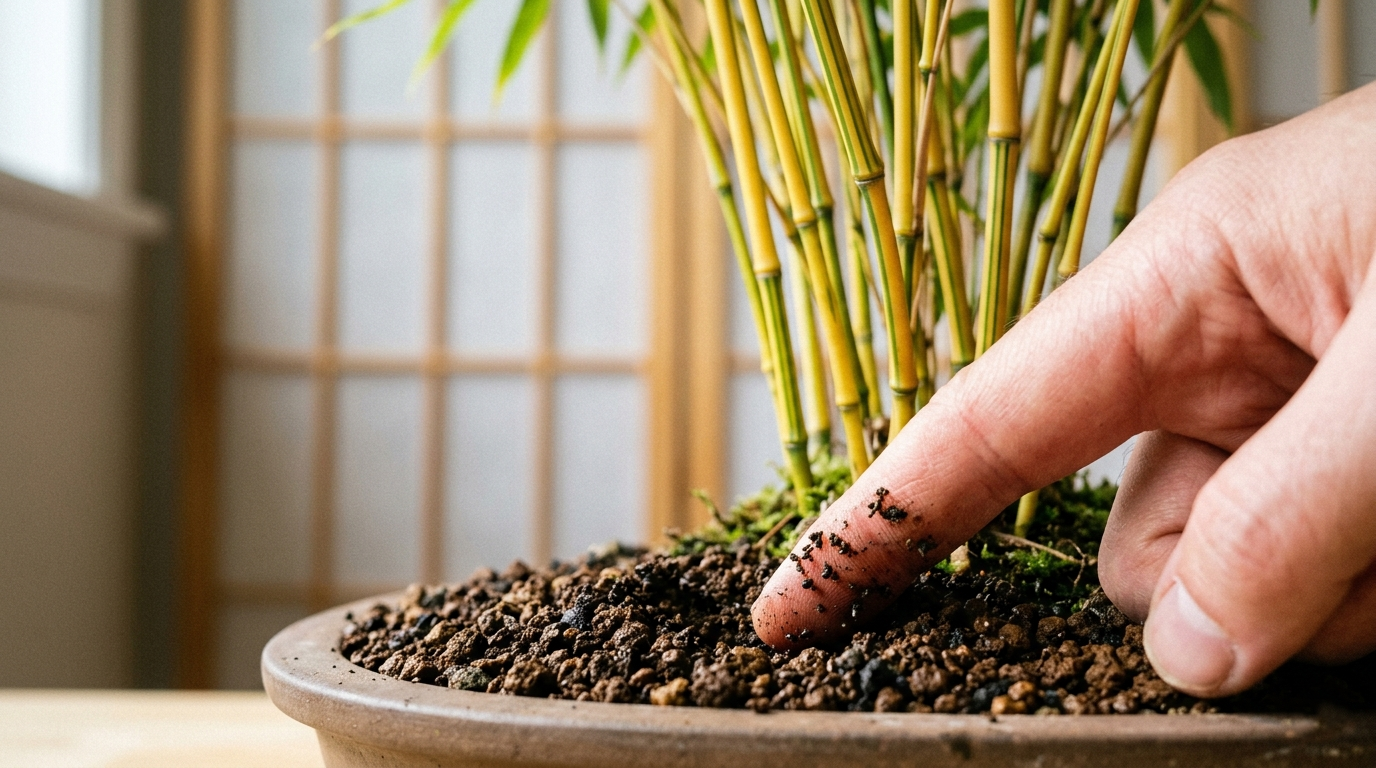
Gently press your index finger 1 inch deep into the soil matrix, or insert a clean, unfinished wooden chopstick deep into the center of the root ball for 10 seconds. When you pull it out, inspect the wood:
-
If the chopstick is dark, damp, and has soil clinging to it, the root zone is sufficiently hydrated. Do not water.
-
If the chopstick comes out completely dry and light in color, you are approaching a critical dehydration event. Water immediately.
The ideal state for bamboo bonsai soil is to remain consistently damp, feeling exactly like a thoroughly wrung-out kitchen sponge—never muddy or swamp-like, but never allowed to bake dry into a hard, dusty block.
Deciphering Leaf Language
-
Symptom: Leaves curled tightly inward lengthwise. This means emergency under-watering. The plant is reducing its leaf surface area to completely halt moisture loss. Immediately submerge the entire pot in a basin of tepid water for 15 minutes to fully re-saturate the dry core.
-
Symptom: Leaf tips turning a translucent yellow and dropping. This indicates over-watering or anaerobic soil conditions. The roots are drowning in stagnant water and rotting due to a complete lack of oxygen. Halt watering immediately and check that drainage holes aren’t blocked.
Water Quality Protocol
The fine, hair-like rootlets of miniature bamboo are highly vulnerable to chemical toxicity. Raw municipal tap water is heavily treated with chlorine, chloramines, and fluoride. Over time, these chemicals accumulate within the confined soil of a bonsai pot, manifesting as ugly, dark brown necrotic tips across your entire canopy.
To protect your plant, utilize filtered water, reverse osmosis water, or harvested rainwater. If you must use municipal tap water, let it sit uncovered in an open wide-mouth container for at least 24 hours prior to watering. Always ensure the water is at room temperature to avoid shocking the root system.
V. Substrate Dynamics: Building the Perfect Drainage Matrix

If you take a miniature bamboo plant and pot it into standard, off-the-shelf commercial potting soil, you are signing its death warrant. Standard potting soils are engineered primarily with high concentrations of peat moss and fine organic matter. These materials are designed to hold onto water for as long as possible. In a shallow, compressed bonsai tray, this dense soil packs down tight, trapping water and completely cutting off oxygen to the roots. Without oxygen, root cells suffocate, die, and rapidly succumb to anaerobic root rot.
To satisfy the dual needs of high moisture retention and instantaneous drainage, you must construct a specialized, coarse particle matrix using the following components mixed in equal parts:
1. Akadama (33.3%)
This is a naturally occurring, hard-baked volcanic clay imported from Japan. It is the backbone of professional bonsai worldwide. Akadama possesses a unique molecular structure: it absorbs water and nutrients deep inside its porous particles while leaving the spaces between the particles open for air. As it slowly dries, it changes color from a dark chocolate brown to a light tan, providing a brilliant visual indicator of when your plant needs water.
2. Pumice (33.3%)
Pumice is a highly porous, white volcanic glass rock. It does not break down over time. Its irregular, sharp edges create micro-pockets of trapped air within the soil, ensuring that every time you water, fresh oxygen is pulled down deep into the root zone.
3. Lava Rock or Decomposed Granite (33.3%)
This heavy, coarse component provides excellent structural stability to the mix. It gives the aggressive, woody rhizomes of the bamboo something hard to press against, which naturally triggers the roots to split and ramify into finer, healthier hair-roots rather than circling the pot aimlessly.
The pH Target Range
Bamboo thrives in a slightly acidic to neutral substrate, ideally between 5.5 and 6.5 pH. The combination of Akadama and organic feeding naturally maintains this range. Avoid adding agricultural lime or high-calcium components (like crushed seashells or eggshells) to your mix, as raising the pH past 7.0 will lock up essential iron and manganese, leading to severe chlorosis (yellowing of the foliage).
VI. Nutritional Strategy: Feeding for Form, Not Speed
In traditional landscape gardening, the goal of fertilizing bamboo is to achieve explosive growth, pushing the culms as high and thick as possible. In the art of bonsai, our objective is the exact opposite. We want to cultivate a plant that exhibits immaculate structural health, tight internodes, and tiny, delicate leaves that look perfectly in scale with a miniature presentation. Therefore, our nutritional strategy must be highly controlled and deliberate.
The Fertilizer Blueprint
To prevent your bamboo from throwing out massive, out-of-scale giant leaves and weak, elongated canes, avoid harsh, synthetic high-nitrogen chemical fertilizers. Instead, opt for mild, slow-acting organic options.
-
The Product Choice: Use a balanced, liquid organic fertilizer (such as a high-quality cold-processed fish emulsion or kelp meal formula) with an N-P-K ratio around 5-5-5 or 3-3-3. Alternatively, you can apply traditional compressed organic bonsai fertilizer cakes directly to the soil surface.
-
The Seasonal Schedule: Apply your liquid fertilizer at half of the manufacturer’s recommended strength once every 4 to 6 weeks, starting from the first signs of early spring activity through late autumn.
-
The Winter Pause: As day lengths shorten in winter, miniature bamboo enters a semi-dormant period where its metabolism slows down significantly. Completely halt all fertilization during this time. Forcing nutrients into a resting plant causes a toxic buildup of mineral salts in the soil and triggers weak, pale, spindly winter growth that ruins the tree’s natural silhouette.
VII. Pruning and Shaping: Form without Wire
Shaping a traditional bonsai tree typically involves wrapping heavy copper or aluminum wire around the branches, physically forcing them into artistic shapes over several months. If you try this technique on a bamboo bonsai, you will quickly ruin your specimen.
Bamboo culms are hollow, rigid cylinders of cellulose and silica. They possess no bark layer or malleable wood fibers. If you attempt to bend a hardened bamboo cane with wire, it will not yield; it will simply snap cleanly in half or collapse inward, cutting off the plant’s internal fluid pathways. Therefore, shaping bamboo is achieved entirely through strategic, disciplined pruning and clipping.
The “Haircut” Technique for Foliage Density
To maintain a tight, compact, cloud-like canopy, you must perform regular maintenance clipping during the active spring and summer growing seasons.
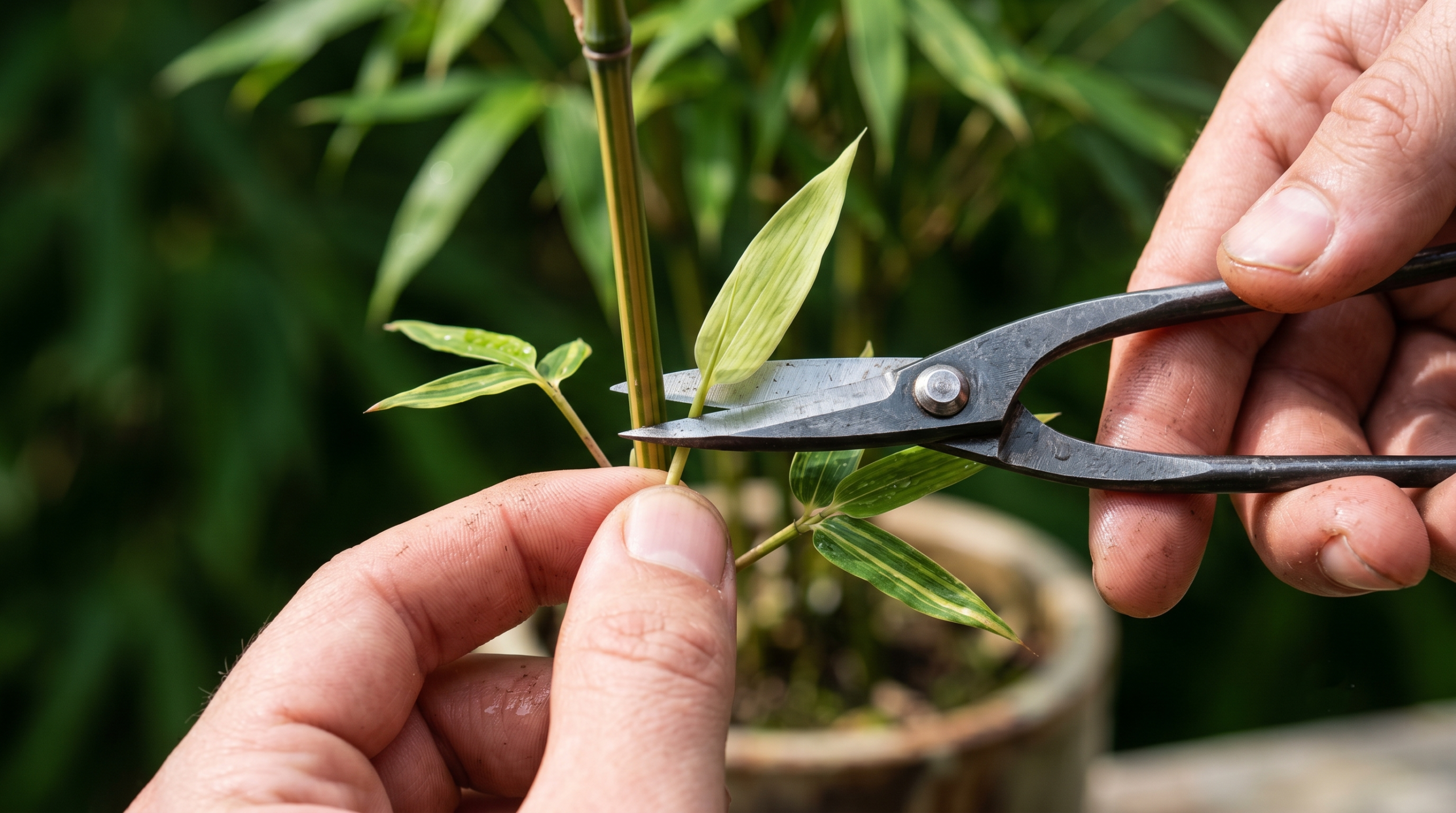
When a new leaf shoot emerges from a branch node, allow it to extend until it opens two or three distinct leaves. Using a pair of ultra-sharp, sterilized bonsai shears, clip the shoot back down, leaving only one or two leaves. This constant pruning disrupts apical dominance, forcing the plant to redirect its energy into awakening dormant buds lower down on the cane, resulting in a much tighter, denser, and visually miniaturized leaf structure.
Cane Renewal and Thinning
As a bamboo grove ages, older canes will naturally begin to lose their vigor, turning a dull pale green or yellowing entirely. To keep the grove looking pristine and to ensure optimal light penetration, you must perform regular thinning:
-
Identify the oldest, weakest, or most poorly positioned culms that are crowding the center of your design.
-
Trace the cane down to the absolute base where it emerges from the soil.
-
Using a pair of sharp, flush-cutting root shears, snip the cane off completely flat at the soil line.
-
This hard thinning mimics natural forest cycles and instantly signals the underground rhizome to send up fresh, vigorous, brightly colored new shoots from the base.
Creating the “Forest” Landscape
When arranging multiple bamboo culms in a shallow oval tray to create a classic forest scene, always work with odd numbers (3, 5, 7, or 9 canes). This avoids unnatural, rigid symmetry. Position your thickest, tallest cane slightly off-center to serve as your focal point, and arrange smaller canes around it at varying distances and depths. This illusion creates a powerful sense of perspective, making a 12-inch container look like a vast, deep wild woodland.
VIII. Repotting and Rhizome Management
Because bamboo is a highly active grass, its underground root development is incredibly fast and powerful. Within a single growing season, a healthy miniature bamboo plant can completely pack a shallow bonsai pot with a dense, solid mat of tough, fibrous roots and horizontal rhizomes. If left unchecked for two or more years, the expanding root mass will literally push the soil out of the pot, blocking water from penetrating and starving the plant. Annual spring intervention is essential.
Step-by-Step Repotting Sequence
-
Extract: Run a flexible spatula around the inside rim of the pot to loosen the root block, then lift the plant out.
-
Tease: Use a single-pronged root rake or an old kitchen fork to gently comb out the outer 20% of the compressed roots.
-
Prune: Trim back long, circling roots and cut away thick, woody, non-productive yellow rhizomes by up to one-third.
-
Replant: Set the plant back into the tray using fresh, pre-mixed Akadama, Pumice, and Lava substrate. Water thoroughly.
Post-Repotting Recovery Care
Root pruning is a surgical procedure that temporarily reduces the plant’s ability to absorb water. To ensure your bamboo recovers without dropping leaves, follow this aftercare protocol for the next 14 to 21 days:
-
Move the pot to a bright location completely protected from direct afternoon sunlight and windy drafts.
-
Do not fertilize. Applying fertilizer to freshly cut, healing roots will instantly burn the open tissues and kill the plant.
-
Keep the substrate consistently damp, and mist the foliage two to three times daily with room-temperature filtered water to reduce moisture loss through the leaves while the root system re-establishes itself.
IX. Troubleshooting Pests & Pathology
Even with meticulous care, the indoor environment can occasionally tilt in favor of pests and diseases. Because miniature bamboo has very fine leaves and tight groupings of stems, catching an infestation early is the difference between a simple fix and losing the entire plant.
Indoor Invaders
-
Spider Mites: These microscopic arachnids thrive in warm, dry air spaces. They live on the undersides of leaves, sucking out vital plant juices. The first warning sign is a subtle, dusty loss of color across the leaves, followed by ultra-fine silken webbing. Immediately wash the plant under a gentle spray of running water, then thoroughly spray the entire canopy with a solution of diluted neem oil or insecticidal soap every 4 days for two weeks.
-
Fungus Gnats: These small black flies crawl across the soil surface, laying eggs in damp organic matter. Switch to the purely mineral substrate mix outlined in Section V (Akadama, Pumice, and Lava). Because this mix contains zero organic peat or compost, the gnats have no food source and the infestation will naturally collapse.
Pathological Control
-
Leaf Rust and Fungal Spots: This condition presents as unsightly orange, brown, or black powdery spots spreading across the foliage. It occurs when water sits statically on the leaves for extended periods in a room with poor air circulation. Use sterilized shears to clip off all affected leaves. Immediately relocate the plant to a spot with active air movement and apply water directly to the soil substrate, avoiding wetting the foliage late in the evening.
X. High-Value FAQ Section
Q: Can my bamboo bonsai survive outdoors?
A: Yes, and they highly benefit from it. While this guide focuses on indoor maintenance, true dwarf bamboos thoroughly enjoy being placed outdoors in a bright, sheltered garden location during the warm spring and summer months. The abundance of natural sunlight, rain, and fresh air movement will turbocharge their health. However, because their roots are housed in a shallow, vulnerable bonsai container, you must bring them back indoors before the first hard autumn freeze hits your region.
Q: Why are my bamboo canes turning a pale white or greyish color?
A: If the canes feel completely solid and firm to the touch, this pale coloration is typically caused by one of two things: natural aging (as bamboo culms mature, many species develop a beautiful, powdery natural waxy coating called “bloom”) or calcium scale buildup. Calcium scale happens if you overhead mist your plant using hard municipal water; the water evaporates, leaving behind white mineral crusts. Wipe the canes gently with a soft cloth dipped in distilled water mixed with three drops of lemon juice to dissolve the scale.
Q: How long can true dwarf bamboo live in a tiny bonsai pot?
A: Provided you adhere strictly to the protocols of annual spring root pruning, soil replacement, proper organic feeding, and careful moisture monitoring, a true bamboo bonsai can easily live for decades. Some historic bamboo specimens in Japanese collections have been maintained in containers for over half a century, gaining incredible character, color depth, and structural refinement with every passing generation.
XI. Conclusion
Mastering bonsai bamboo plant care is a deeply rewarding journey that balances scientific discipline with artistic expression. While it requires more active daily attention than your average indoor plant, the reward of a thriving, pristine miniature bamboo grove is unparalleled. By maintaining a sharp eye on moisture levels, rejecting the temptation of standard potting soils, and engineering a bright, humid indoor microclimate, you can keep this magnificent grass thriving on a micro-scale. Treat your miniature bamboo with the specialized care its genetics demand, and it will remain a captivating centerpiece of tranquility and natural beauty in your home for years to come.