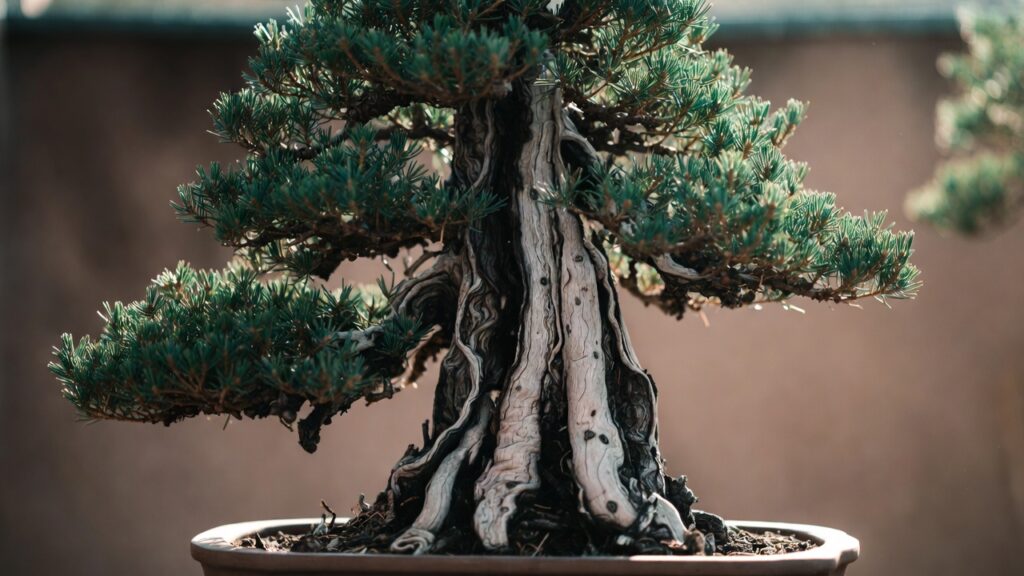

The bald cypress (Taxodium distichum) is one of the most mesmerizing spectacles of the botanical world. In its native southern swamplands, it grows into an ancient, moss-draped giant featuring a dramatically flared trunk and mysterious, knobby “knees” that rise above the water line. For enthusiast indoor gardeners, capturing this primeval aesthetic in miniature by cultivating a bald cypress bonsai tree is the ultimate horticultural triumph.
However, trying to raise this majestic, deciduous wetland conifer inside a modern home presents a unique, fascinating challenge. If you simply treat it like a standard houseplant, it will fail. To succeed, you must learn how to manipulate artificial light, balance a hyper-specific watering regime, and simulate a crucial winter dormancy period within an indoor microclimate.
Whether you have just purchased your first pre-bonsai specimen or are trying to save a struggling tree, this comprehensive, expert-vetted skyscraper guide provides the exact blueprint you need to keep your indoor bald cypress thriving for decades.
Understanding the Bald Cypress (Taxodium distichum)

To successfully master the art of growing a bald cypress bonsai tree indoors, you must first understand its evolutionary adaptations. In the wild, these trees are dominant forces in the floodplains, bayous, and swamps of southeastern North America. They are uniquely adapted to prolonged submersion, saturated soils, and distinct seasonal shifts.
Natural Habitat vs. Indoor Microclimate
The primary reason indoor cultivators struggle with this species is a failure to reconcile the natural habitat with a home environment. In the wild, a bald cypress experiences intense, unfiltered sunlight, high ambient humidity, and a continuous flow of nutrient-rich water.
When brought indoors, the tree faces stagnant air, low light levels, dry ambient air from heating or air conditioning systems, and restricted root space. To bridge this gap, your goal as a bonsai artist is not to force the tree to adapt to your living room, but rather to construct a highly localized “swamp microclimate” around the tree.
The Deciduous Nature: Preventing Autumn Panic
One of the most critical warnings for any indoor grower is this: the bald cypress is a deciduous conifer.
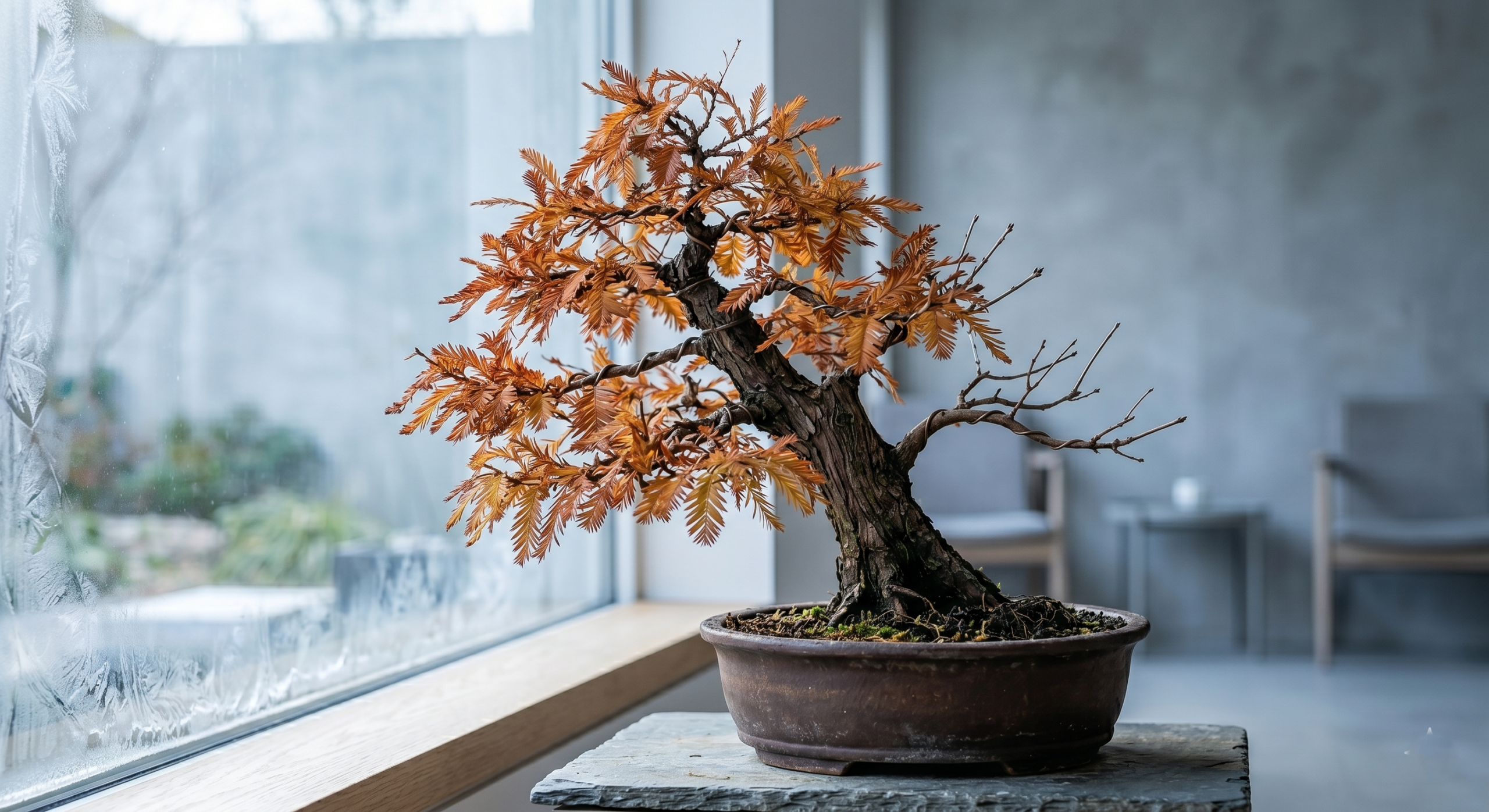
Unlike junipers or pines that remain green year-round, your bald cypress bonsai will drop its needles in late autumn. Before they fall, the feathery leaves transform into a breathtaking tapestry of copper, rust, and fiery orange.
For an indoor grower unaccustomed to this cycle, watching a prized bonsai drop all its foliage can cause absolute panic. Rest assured, this process is entirely normal, highly necessary, and a sign of a healthy tree entering its seasonal rest.
Anatomy of a Swamp Giant in Miniature
When styling this species, you are aiming to replicate specific anatomical features that define mature wild specimens:
-
The Foliage: The needles are soft, flat, and arranged alternately on the twigs, creating a highly delicate, feathery appearance that looks exquisite in miniature.
-
Trunk Flaring and Buttressing: In response to wet soils, the base of a bald cypress naturally develops a wide, heavily flared buttress. We can replicate this in a bonsai pot through specific root-spreading and watering techniques.
-
The Myth and Reality of “Cypress Knees”: In nature, these trees grow pneumatophores (knees) out of their root systems, historically believed to assist with oxygen exchange. While it is exceptionally rare for a bonsai to develop true knees due to container limitations, advanced growers can sometimes encourage small root knobs by allowing specific surface roots to grow unchecked in deeply submerged conditions over several years.
The Core Pillars of Indoor Care
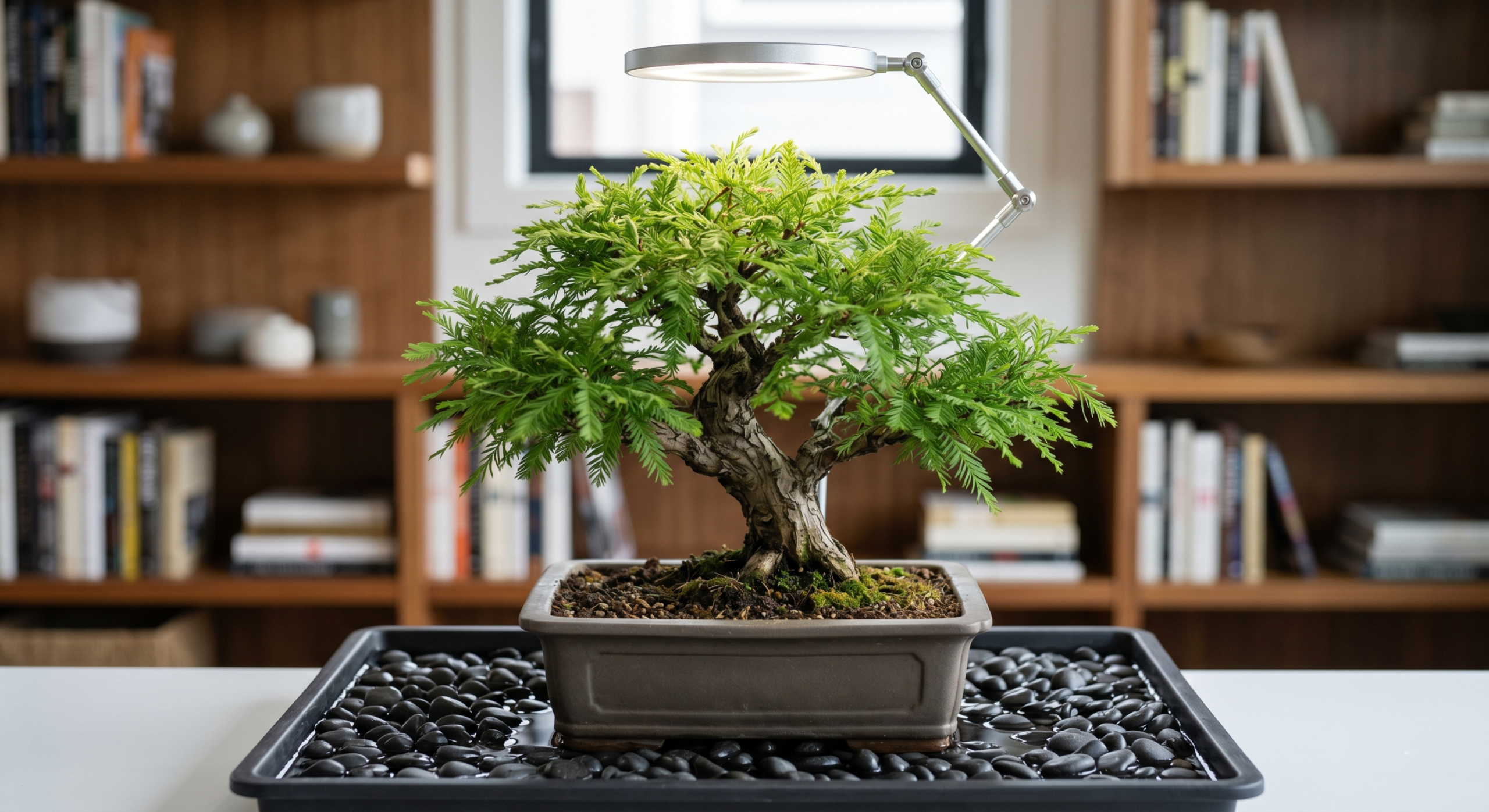
To keep your tree healthy throughout the active growing season, you must optimize three foundational elements: lighting, watering, and soil substrate.
1. The Lighting Dilemma (Replicating Full Sun)
The bald cypress is a sun-worshipper. In its natural environment, it demands full, direct sunlight to power its explosive growth rates. Indoors, standard window light—even a large south-facing window—is rarely sufficient on its own to sustain long-term vitality.
Without adequate light, the tree will exhibit long, leggy inner branching, large needles, and a general decline in vigor.
The Artificial Lighting Solution
To successfully grow this species indoors, you should invest in a dedicated, high-output LED grow light system. Look for full-spectrum LED lights that deliver high Photosynthetically Active Radiation (PAR) levels.
-
Intensity: Aim for a setup that provides at least 300 to 500 $\mu mol/m^2/s$ of light at the canopy level.
-
Photoperiod: During the peak spring and summer growing season, keep your grow lights on for 14 to 16 hours a day. This long photoperiod mimics mid-summer swamp conditions and drives rapid photosynthetic activity, allowing the tree to build up the heavy starch reserves it needs for winter survival.
2. The “Swamp Simulation” Watering Method
With most indoor plants, root rot caused by overwatering is the number one killer. The bald cypress flips this rule entirely on its head. This tree possesses specialized cellular adaptations (including aerenchyma tissue) that allow its roots to thrive in anaerobic, waterlogged conditions.
You cannot overwater a bald cypress during the growing season; however, allowing the soil to dry out completely can be fatal in a matter of hours.
Technical Specification: Seasonal Hydration and Substrate Saturation Protocols
| Operational Phase | Calendar Window | Environmental Parameters | Irrigation & Substrate Management Protocol |
| Active Vegetative Phase | Spring through Late Summer (Bud-Burst to Initial Foliar Color Shift) | High-intensity photoperiod, elevated ambient temperatures, rapid transpiration. | Submersion Protocol: The lower $1/2$ to $1$ inch ($1.3$ to $2.5\text{ cm}$) of the container must remain continuously submerged in a shallow freshwater reservoir. Flush thoroughly from the surface daily to refresh dissolved oxygen levels within the substrate core. |
| Metabolic Dormancy Phase | Late Autumn through Winter (Post-Foliar Abscission to Bud-Swell) | Reduced photoperiod, depressed temperatures ($35^\circ\text{F}$ to $55^\circ\text{F}$ / $1.6^\circ\text{C}$ to $12.7^\circ\text{C}$), arrested vascular activity. | Moist-Retention Protocol: Extract the container from the submersion reservoir entirely. Maintain a consistently damp substrate profile via targeted top-watering. The root zone must never experience complete desiccation or prolonged anaerobic stagnation. |
The Water-Tray Submersion Technique
From the moment the buds burst open in the spring until the leaves begin to turn copper in autumn, your bald cypress bonsai tree pot should ideally sit continuously in a shallow tray filled with water.
-
Depth: Fill the tray so that the bottom $1/2$ to $1$ inch of the bonsai pot is submerged.
-
Flushing: To prevent the water from becoming stagnant and breeding anaerobic pathogens or salt buildup, flush the pot from the top with fresh water every single day. This draws fresh oxygen down through the soil profile while keeping the root zone saturated.
-
Winter Adjustment: Once the tree sheds its leaves and enters winter dormancy, it stops actively drawing water. At this point, remove the pot from the water tray completely. Shift your watering routine so that you keep the soil consistently damp and moist, but never soggy or bone-dry.
3. Creating the Ideal Indoor Substrate
Because the bald cypress requires an immense amount of moisture, traditional, ultra-fast-draining bonsai soil mixes designed for conifers (such as a 1:1:1 mix of pure Akadama, pumice, and lava rock) are not ideal for indoor cultivation. The dry air of a home will cause these mixes to dry out too quickly.
Instead, you need a customized substrate that balances structural integrity with high water retention.
The Ideal Substrate Recipe
An excellent, field-tested indoor soil recipe for bald cypress consists of:
-
40% Akadama (Fine to Medium particle size): To provide water retention and encourage excellent root branching.
-
30% High-Quality Organic Potting Compost or Peat Moss: This component is vital for holding onto consistent moisture and providing a buffer against rapid drying.
-
30% Non-porous Grit (Pumice or Coarse Quartz Sand): To ensure that even when the soil is completely saturated, there are still microscopic macro-pores that allow minimal air movement and prevent complete soil compaction.
Managing Indoor Temperature & The Critical Dormancy Phase
This is where many indoor bonsai growers run into a wall. Because the bald cypress is a temperate tree, it has an internal biological clock that dictates a mandatory period of rest.
If you keep your tree under warm indoor temperatures and long grow-light cycles year-round, it will skip dormancy. While it may look healthy for the first winter, this lack of rest exhausts the tree’s metabolic resources. By the second or third year, the tree will experience sudden, inexplicable dieback and ultimately perish.
Simulating Autumn Indoors
To trigger a natural dormancy phase, you must signal to the tree that winter is approaching. Starting in mid-to-late October, begin reducing the photoperiod of your grow lights from 16 hours down to 10 hours over the course of three weeks. Simultaneously, move the tree to a cooler spot in your home, such as a windowsill right up against the glass or a cooler utility room.
As the temperatures drop below 60°F (15°C), you will watch the feathery foliage undergo its signature autumn color shift before dropping away completely.
The Indoor Dormancy Protocol
Once the tree is completely bare, its root system requires a cold rest period of between 60 to 90 days where temperatures remain consistently between 35°F and 55°F (1.6°C to 12.7°C). You have two highly reliable options to achieve this indoors:
Option A: The Cool Room / Unheated Space Method
If you have access to an unheated basement, an attached garage that does not freeze solid, a cold frame, or an enclosed porch, this is the ideal wintering location.
The goal is to keep the tree cold enough to prevent it from waking up early, but protected from extreme, deep freezes below 25°F (-4°C), which can easily damage the delicate root systems contained within a small ceramic bonsai pot.
Option B: The Refrigerator Method
For urban apartment dwellers without access to cold utility rooms, the refrigerator is a highly effective alternative.
-
Once the tree has completely dropped its needles, thoroughly water the soil and spray the bare branches with a mild copper-based fungicide to prevent mold growth in the dark, humid fridge environment.
-
Enclose the pot and root ball in a plastic bag to lock in moisture, leaving the top trunk and branches exposed.
-
Place the bonsai into a standard kitchen refrigerator set between 36°F and 40°F (2°C to 4°C). Check the soil moisture every two weeks; it should remain damp but never waterlogged. Since the tree has no leaves, it does not require any light during this time.
Spring Awakening
In early spring (typically late February to mid-March), remove the tree from its cold storage. Place it back under your high-output LED grow lights and restore the photoperiod to 12 hours, gradually increasing it back to 16 hours as new growth emerges.
You will soon see vibrant, lime-green buds bursting forth from the seemingly dead bark—a truly rewarding sight.
Advanced Styling and Shaping Techniques
The growth habit of a bald cypress bonsai tree is distinctly different from most other conifers. They grow with incredible speed and vigor during the summer months. This rapid cell division requires a specialized approach to training and styling.
The Structural Challenge: Managing Aggressive Growth
Because the branches of a bald cypress thicken so quickly, traditional aluminum or copper bonsai wire can cause severe problems. If you wrap wire tightly around a fast-growing spring shoot, it can bite into the delicate, fibrous bark within a matter of 2 to 3 weeks, leaving permanent, ugly scars that take years to heal out.
The “Guy-Wire” and Tie-Down Method
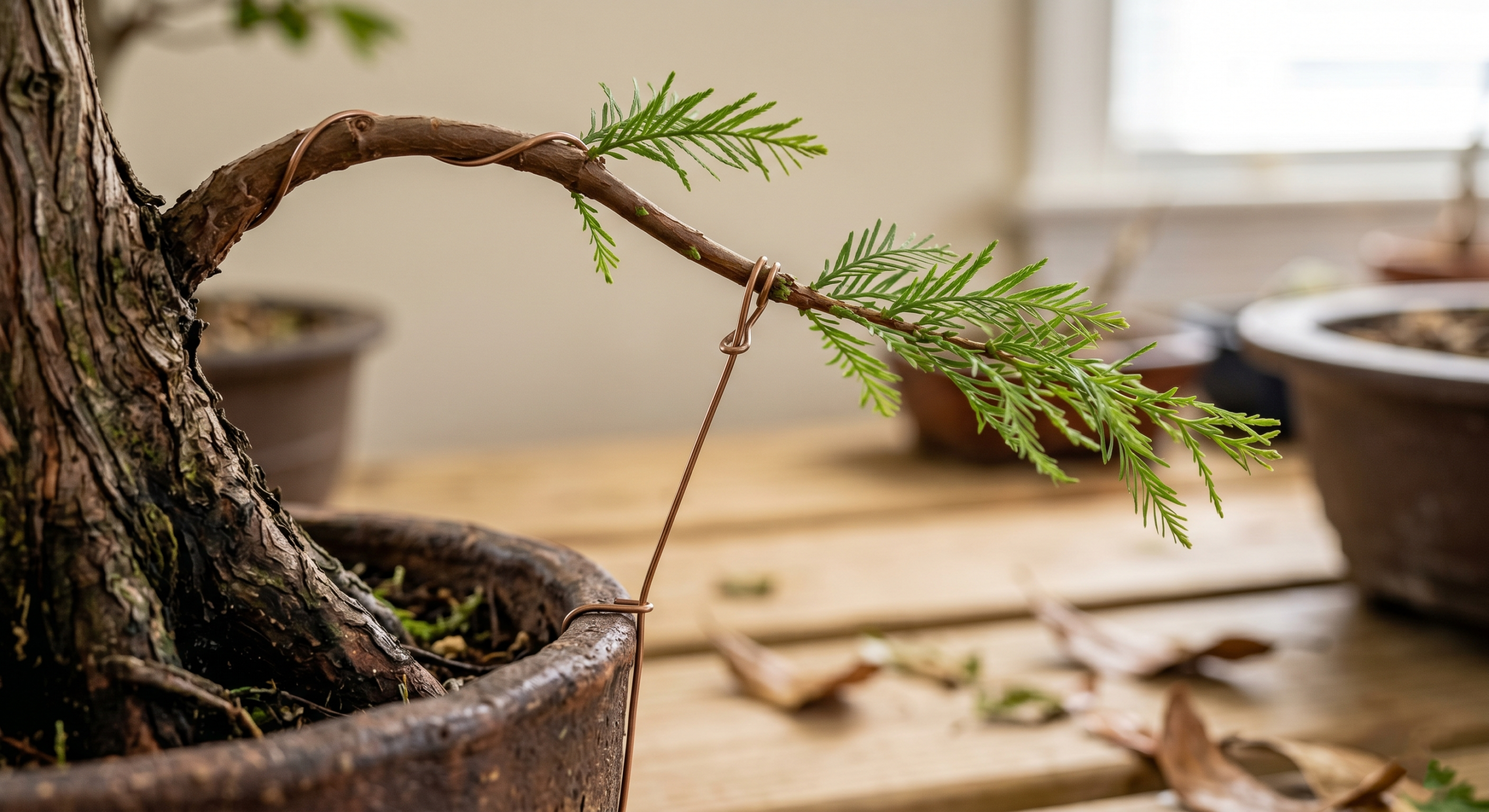
To avoid wire scars while still achieving the classic, downward-sloping look of an old, heavy swamp tree, master growers rely heavily on guy-wires.
Mechanical Protocol: Structural Guy-Wire Branch Realignment
To permanently alter the architectural trajectory of a major branch without compromising the integrity of the fast-growing cambium, the guy-wire tension technique should be utilized as follows:
The Core Axis (Main Trunk): Establish the primary vertical vector of the tree as the central anchor line.
The Natural Vector (Pre-Tension Branch): Identify the target branch, which naturally exhibits an acute, upward growth pattern relative to the main trunk.
The Tension Vector (Guy-Wire Application): Loop a soft, insulated tension wire over the upper third of the target branch. Draw the wire downward and outward at a oblique angle, applying gradual mechanical pressure until the branch settles into a horizontal or slightly downward-sloping orientation that mimics a mature, heavy canopy.
The Anchor Interface (Pot Rim): Terminate the lower end of the tension wire by securing it firmly to a fixed external anchor point, such as the pre-drilled holes or the structural lip of the ceramic pot rim. This structural layout bypasses the need for traditional spiral coil wrapping, entirely eliminating the risk of bark scarring during periods of rapid trunk thickening.
Instead of coiling wire around the entire length of a branch, loop a small piece of soft wire insulated with a rubber tube or aquarium tubing over the branch you wish to lower.
Pull the branch down gently to the desired angle, and anchor the other end of the wire directly to the rim of the bonsai pot or to the heavy base of the trunk. This allows the branch to grow, flex, and thicken naturally without any metal touching its expanding bark surface.
The “V-Notch” Cut Technique
For thick, older branches that have become too stiff to bend using traditional methods, you can employ the advanced V-notch technique.
Using a fine Japanese pruning saw, cut a small, clean, V-shaped wedge out of the underside of the branch right where it joins the trunk. Carefully press the branch downward until the gap closes, and secure it firmly in place with a heavy guy-wire. Apply cut paste generously over the wound.
Because bald cypresses boast an exceptional healing response, the cambium layer will quickly fuse the cut back together, permanently altering the branch angle.
Pruning and Pinching Schedules
Achieving fine ramification (the dense network of smaller twigs) requires a strict, multi-step maintenance routine throughout the year:
-
Late Winter Pruning: While the tree is still dormant and bare of leaves, evaluate its structural framework. This is the perfect time to make large structural cuts, remove crossing branches, and clean up the silhouette.
-
Summer Finger-Pinching: Once the long spring shoots extend and produce 4 to 6 inches of growth, do not let them run wild unless you are intentionally trying to thicken that specific branch. Instead, use your thumb and forefinger to cleanly pinch off the tender green tips of the extending shoots. This halts elongated growth and forces the tree to push out secondary buds closer to the interior trunk, building dense, cloud-like foliage pads.
-
The Power of the Trunk Chop: If you are starting with young nursery stock that lacks a thick, tapered base, the fastest route to an authentic bonsai form is a drastic trunk chop. Allow the tree to grow completely unchecked in a large container for a full year to swell the base, then cleanly slice off the main trunk at a 45-degree angle just above a lower branch. Train that lower branch upward as the new apex. The extreme taper created by this technique instantly gives the illusion of a massive, ancient tree.
Feeding and Nutrition for Rapid Development

Because your indoor bald cypress is kept under intense grow lights and provided with abundant water, its metabolic rate will be remarkably high. It will quickly exhaust the nutrients present within your limited potting substrate. To support continuous, vibrant green growth and rapid trunk thickening, you must implement an aggressive fertilization schedule.
The Organic vs. Chemical Approach
For indoor cultivation, a balanced hybrid approach works best.
During the peak spring push, use a high-nitrogen organic fertilizer cake or liquid drench (such as fish emulsion or kelp meal). Organic fertilizers break down slowly over time, providing a continuous, gentle stream of micronutrients while fostering a healthy microbial ecosystem within your potting soil.
The Seasonal Schedule
-
Early Spring (Bud-Swell to Leaf-Out): Apply a balanced organic fertilizer every 2 weeks to fuel the explosive initial flush of feathery needles.
-
Late Spring to Mid-Summer: Supplement your organic program with a water-soluble chemical fertilizer (e.g., a balanced 20-20-20 formulation) applied at half-strength every week. Because you are continuously flushing the soil with your watering routine, this frequent feeding ensures that nutrients are always available to the active root zone.
-
Late Summer to Early Autumn: Shift your fertilizer formulation away from high nitrogen toward a mix higher in phosphorus and potassium (low N, high P-K, such as a 0-10-10 or 3-12-12). This signals to the tree to stop producing soft, succulent green shoots—which would easily perish in winter—and instead focus its energy on lignifying (woody hardening) its new branches and strengthening its root walls for the upcoming dormancy phase.
Repotting and Root Management
The root system of a healthy bald cypress grows with ferocious speed. In an indoor environment with optimal heat and light, the roots can easily fill a container within a single season, circling the inside of the pot and pushing the entire tree upward out of its ceramic home.
Repotting Frequency and Timing
Young indoor bald cypresses typically require repotting every single year, while older, more established specimens can safely go two to three years between soil changes.
The absolute best window for this operation is early spring, precisely when the tiny, dormant brown buds on the trunk begin to swell and show a hint of bright green color. Repotting too early when the tree is dead-dormant can cause root desiccation, while waiting until the feathery leaves have fully extended will cause severe transplant shock.
Step-by-Step Repotting Guide
-
Extraction: Carefully run a root-pruning knife around the inner perimeter of the bonsai pot to loosen the soil mass, and gently lift the tree out.
-
Comb and Clean: Use a sturdy root rake or chopstick to gently comb out the tightly wound outer roots. Work from the center outward, teasing away about 30% to 50% of the old, exhausted soil substrate.
-
Root Pruning: Use sharp, sterile root cutters to prune back long, thick downward-pointing taproots. Focus on preserving the fine, fibrous lateral root hairs, as these are the primary engines responsible for moisture and nutrient uptake. Aim to flatten out the bottom of the root system to encourage a beautiful, radiating surface root base (known as nebari).
-
Securing the Tree: Always loop heavy-gauge anchor wires through the drainage holes at the bottom of your bonsai pot and wrap them securely around the core root base. Because this species loves high-moisture soils, any shifting or rocking caused by handling can snap newly forming root tips, severely delaying recovery.
-
Aftercare: Thoroughly saturate the new soil until water runs completely clear out of the bottom drainage holes. Keep the tree out of direct, intense air currents and skip the water submersion tray for the first two to three weeks. Instead, keep the soil damp and let the roots breathe slightly as they regenerate into the fresh substrate.
Troubleshooting Indoor Pests and Diseases
Even inside the clean confines of a home, a bald cypress bonsai tree can occasionally fall victim to health issues. Recognizing the early symptoms is key to maintaining long-term vitality.
Common Problems and Solutions
| Symptom | Potential Cause | Exact Treatment Protocol |
| Tiny, fine webbing on the feathery needles; foliage looks dull, dusty, and begins to bronze prematurely. | Spider Mites (Common in dry indoor rooms) | Immediately isolate the tree. Thoroughly blast the foliage with a stream of tepid water to mechanically dislodge the pests. Treat the entire canopy with an organic insecticidal soap or a 1% solution of pure Neem Oil, ensuring you coat both the tops and bottoms of the needle clusters. Repeat every 5 days for three cycles. |
| White, cottony tufts forming around the branch crotches or deep within the fibrous bark furrows. | Mealybugs | Dip a cotton swab in 70% isopropyl rubbing alcohol and dab it directly onto the visible insects to dissolve their protective waxy coating. For severe indoor infestations, apply a systemic soil drench containing imidacloprid during the active growing season. |
| New green tips turn black, wither, and die back suddenly in late spring; white or grey fungal spores visible on twigs. | Twig Blight / Fungal Pathogens | This is a symptom of stagnant indoor air and excessive ambient moisture without air movement. Clip away all infected twigs well below the site of dieback, sterilizing your shears with alcohol between every single cut. Position a small, oscillating personal fan near your grow setup to keep a gentle, continuous breeze moving through the foliage pads. |
| Leaves turn yellow between the veins while the veins themselves remain bright green. | Chlorosis (Iron Deficiency) | Bald cypresses grown in highly alkaline water or soil can struggle to uptake iron. Check the pH of your tap water. If it is high, treat the tree with a supplemental drench of chelated iron and consider switching to collected rainwater or reverse-osmosis water for your daily routines. |
Comprehensive Summary: The Four-Seasons Indoor Care Matrix
To help you visualize your responsibilities throughout the year, use this quick-reference matrix to manage your indoor care routine:
Spring (Awakening & Growth)
-
Light: 12 to 14 hours of high-intensity LED grow lights.
-
Watering: Place pot in water tray once buds emerge; flush daily.
-
Fertilizing: High-nitrogen organic fertilizers every 2 weeks.
-
Key Operations: Repotting just as buds swell; structural pruning before leaves expand.
Summer (Refinement & Styling)
-
Light: Maximize photoperiod to 16 hours daily.
-
Watering: Maintain water tray continuously ($1/2$ to $1$ inch deep); never allow to dry out.
-
Fertilizing: Half-strength balanced liquid chemical feed weekly.
-
Key Operations: Finger-pinching new growth to build dense pads; applying guy-wires to adjust branch placement.
Autumn (The Transition)
-
Light: Gradually reduce photoperiod down to 10 hours to simulate seasonal change.
-
Watering: Remove pot from the water tray once needles turn copper; keep soil evenly moist.
-
Fertilizing: Switch to zero-nitrogen, high-potassium formulas to harden wood.
-
Key Operations: Enjoy the spectacular autumn color display; clean up fallen needles promptly to maintain hygiene.
Winter (Mandatory Dormancy)
-
Light: Minimal to none required if completely bare and dormant.
-
Watering: No water tray. Keep soil consistently damp, checking every 10–14 days.
-
Fertilizing: Stop all fertilization completely.
-
Key Operations: Move tree to cold frame, unheated room, or refrigerator ($35^\circ\text{F}$ to $55^\circ\text{F}$) for 60 to 90 days.
Frequently Asked Questions
Can a bald cypress bonsai live indoors permanently?
Yes, but only if you provide a dedicated cold dormancy phase every single year. While the tree can remain indoors under high-intensity grow lights for its spring and summer growth cycles, it must be moved to a cold environment (like an unheated room, porch, or refrigerator) during the winter months to rest. Without this seasonal down-time, the tree’s health will steadily decline until it dies.
Why are my bald cypress bonsai needles turning brown and falling off?
If this occurs in late autumn (October to November), it is a completely natural part of the tree’s deciduous cycle. The needles turn copper-brown and shed before winter dormancy. However, if this happens during the peak spring or summer growing seasons, it is a sign of acute underwatering, spider mite damage, or chemical root burn. Ensure your tree’s pot is sitting in a water tray during warm weather and check for fine webbing on the twigs.
How do I get my bald cypress bonsai to grow “knees”?
In nature, bald cypress knees (pneumatophores) grow from mature root systems in wet, swampy terrain. Getting them to grow inside a confined bonsai pot is incredibly difficult. You can sometimes encourage small, knobby root projections over several years by planting the tree in a deep container, keeping the water level consistently high above the soil surface, and allowing prominent surface roots to grow unchecked without pruning them.
Is tap water safe for a bald cypress bonsai tree?
Generally, yes, as these trees are quite resilient. However, if your municipal tap water is exceptionally hard and high in lime or chlorine, it can cause the soil pH to rise over time, leading to iron chlorosis (yellowing needles). For best results, allow your tap water to sit out in an open container for 24 hours to dissipate chlorine, or use collected rainwater or distilled water supplemented with a balanced micronutrient fertilizer.
Conclusion
Cultivating a bald cypress bonsai tree indoors is an incredibly rewarding journey that challenges and refines your skills as a grower. By shifting away from standard houseplant rules and embracing the unique biology of this swamp conifer, you can successfully maintain a miniature slice of ancient Americana right inside your living room.
The secret lies entirely in consistency: providing the blazing, full-spectrum light it craves in the summer, keeping its roots happily waterlogged during the peak growing season, and respecting its biological clock by giving it a cold, quiet winter rest.
As you master these core pillars, your bald cypress will reward you year after year—transitioning beautifully from the delicate, lime-green feathers of spring to the fiery copper tones of autumn, standing as a true testament to your horticultural dedication and expertise.