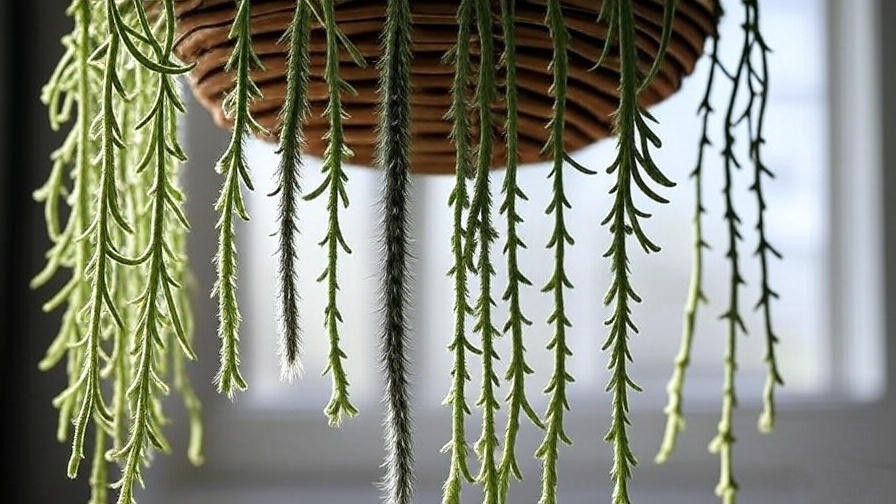
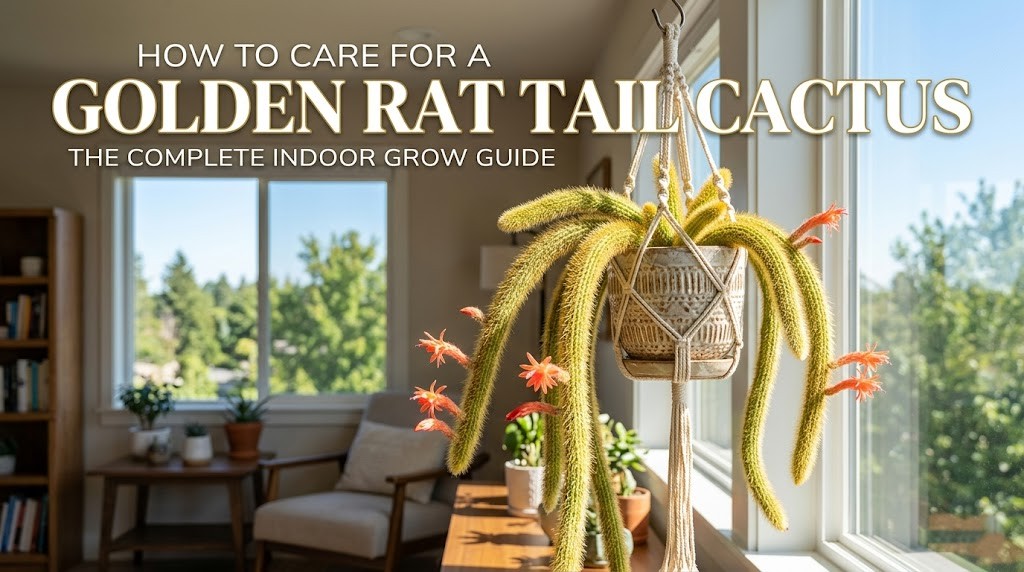
Few houseplants possess the ability to completely transform an indoor space quite like a mature, cascading cactus. If you are looking for a show-stopping statement piece that combines architectural drama with vibrant, desert beauty, learning how to properly care for a golden rat tail cactus (Cleistocactus winteri) is one of the most rewarding gardening endeavors you can undertake. With its brilliant, densely packed golden-yellow spines and unique trailing stems that plunge downward like a mythical creature’s tail, this Bolivian native has quickly skyrocketed in popularity among interior designers and plant enthusiasts alike.
However, moving a plant from the high-altitude, sun-drenched cliffs of South America into a modern home presents distinct challenges. Many indoor growers face frustrating setbacks—such as shriveling tails, a loss of that signature golden luster, or sudden collapse due to root rot.
This comprehensive, expert-backed skyscraper guide is designed to eliminate the guesswork. Whether you are aiming to trigger an abundance of brilliant salmon-pink flowers or simply trying to keep your first specimen alive, this blueprint will provide the precise, actionable insights you need to help your plant thrive.
Understanding the Golden Rat Tail Cactus: Origin & Characteristics
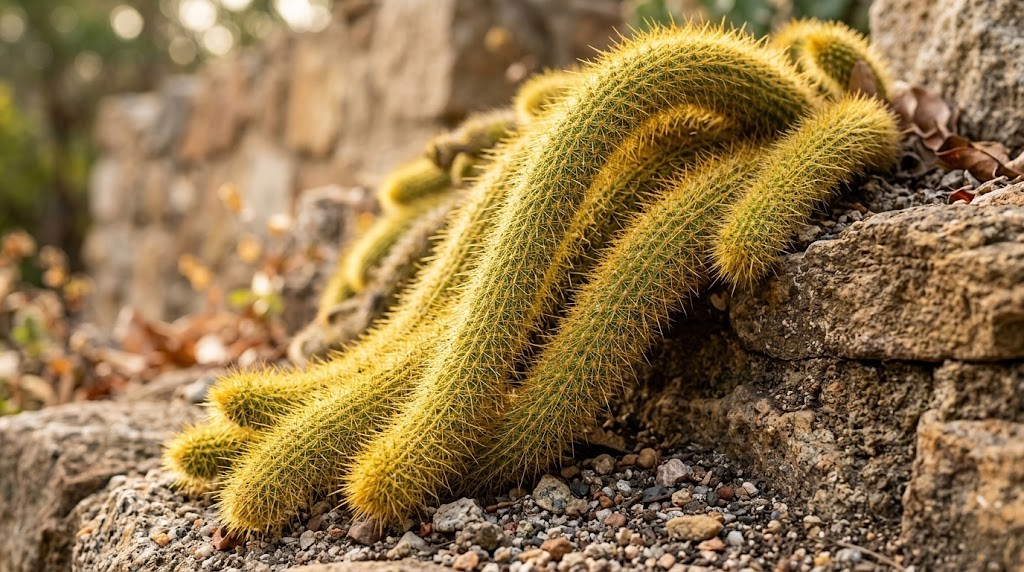
To successfully cultivate Cleistocactus winteri indoors, we must first look at its natural origins. True horticultural expertise always begins with understanding a plant’s native ecosystem.
Native Habitat Context
The golden rat tail cactus is endemic to the cliff faces and steep rocky outcroppings of Bolivia, specifically within the department of Santa Cruz. In these mountainous terrains, the plant grows lithophytic or semi-epiphytic, anchoring its root system into shallow rock crevices, decomposed granite, and minimal organic debris.
This environment tells us three critical things about its indoor preferences:
-
Impeccable Drainage: Water rushes past the roots instantly during rainfall; it never sits in a stagnant, soggy bog.
-
Intense Ambient Light: Growing on exposed cliffs means it receives unfiltered alpine sunlight for most of the day.
-
Pronounced Microclimates: Exposure to persistent winds and stark temperature drops between day and night keeps the air around the plant dry and dynamic.
Distinguishing Cleistocactus winteri from the Standard Rat Tail Cactus
A common point of confusion in the houseplant community is confusing the golden rat tail cactus with the standard rat tail cactus. While they share a similar trailing habit, they belong to entirely different genera and feature distinct aesthetic and care variations.
-
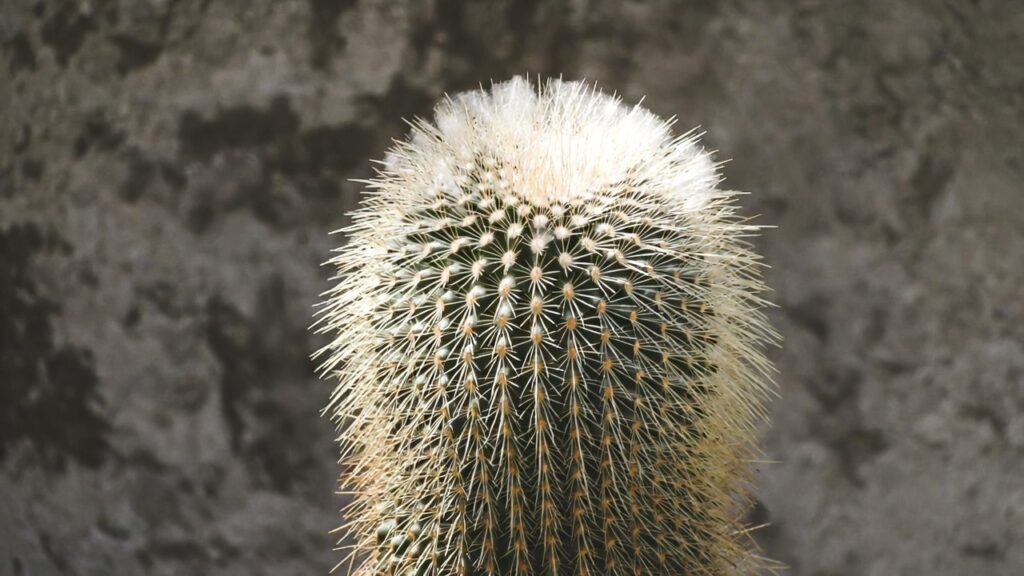
The Golden Rat Tail Cactus (Cleistocactus winteri): Features slightly thicker, sturdier stems covered in a dense, shimmering cloak of short, golden-yellow spines. The spines are soft to the touch from a distance but can act like fiberglass if mishandled. Its flowers are distinctly symmetrical, tubular, and burnished with a striking salmon-orange or pinkish-red hue. It initially grows upright before cascading beautifully under its own weight, with stems reaching up to 3 to 5 feet long over time.
-
The Standard Rat Tail Cactus (Aporocactus flagelliformis): This Mexican native features much thinner, highly pliable, dull green stems with spaced, reddish-brown or gray spines. Its blooms are asymmetric, bright magenta-pink, and look more like zygomorphic orchid flowers.
Recognizing this distinction ensures you are sourcing the correct care templates, as Cleistocactus winteri generally demands higher light intensities to maintain its radiant yellow coloration than its Mexican counterpart.
The Golden Care Blueprint: 5 Critical Growth Factors
Mastering indoor care for this trailing desert marvel requires balancing five primary environmental pillars. Adjusting these factors to replicate its native Bolivian cliffs will yield a vigorous, resilient houseplant.
1. Lighting: Catching the Golden Hour
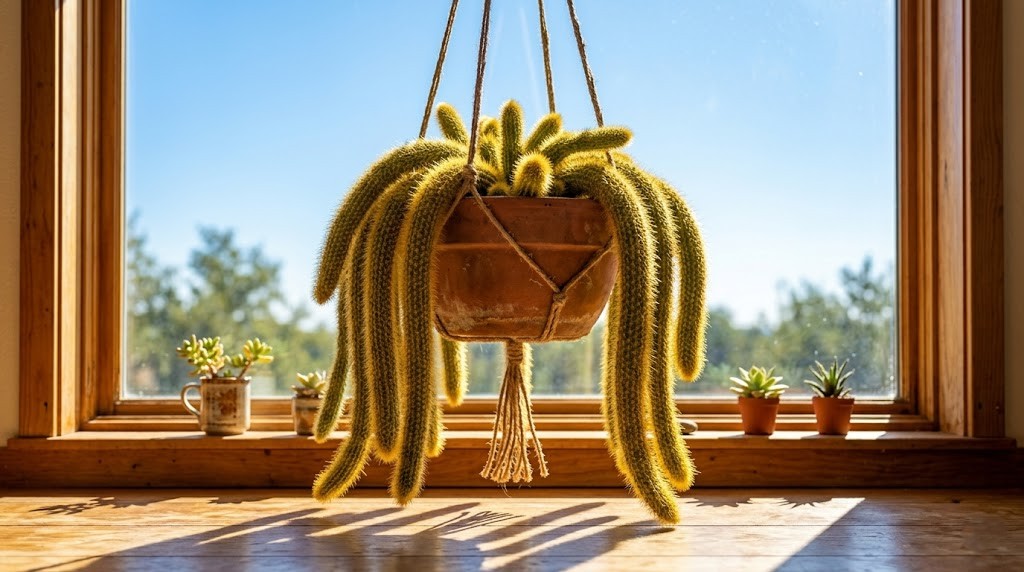
Light is the single most important variable when growing Cleistocactus winteri indoors. Without sufficient light energy, your cactus cannot synthesize enough sugars to sustain its heavy, hanging stems.
-
The Ideal Placement: Position your golden rat tail cactus directly in a South or West-facing window. It requires at least 4 to 6 hours of direct, unfiltered sunlight daily. If you live in the Northern Hemisphere and place this plant in a North-facing window, it will slowly decline.
-
The “Etiolation” Warning: When a cactus receives inadequate light, it suffers from etiolation. This is a physiological condition where the newly emerging tips grow pale, unnaturally thin, and weak as they stretch desperately toward the nearest light source. This ruins the thick, uniform look of the “tails.” If you notice the tips narrowing significantly and losing their golden coloration, it is an immediate distress signal that the plant needs more light.
-
Supplemental Lighting: If your home lacks optimal window exposure, you must utilize high-output LED grow lights. Aim for a full-spectrum grow light positioned 6 to 12 inches above the crown of the plant, running for 12 to 14 hours per day to mimic summer conditions.
2. Watering with Precision (The “Soak and Dry” Rule)
More indoor cacti die from improper watering than from any other cause. The golden rule for watering Cleistocactus winteri is to prioritize the “soak and dry” method, aligning your frequency tightly with the plant’s seasonal life cycles.
-
Active Growing Season (Spring and Summer): During these warm months, the plant actively produces new stem length. Water the plant thoroughly until moisture drains freely out of the bottom of the pot. However, do not water again until the substrate is 100% bone dry all the way to the bottom of the container.
-
How to Test Moisture: Never rely on visual surface inspections. Insert a clean wooden chopstick or a digital moisture meter deep into the root zone. If the chopstick comes out with dark soil clinging to it, or if the meter reads anything above absolute zero, withhold water.
-
Winter Dormancy (Autumn and Winter): As daylight hours shorten and indoor temperatures drop, the cactus enters a rest period. Its metabolic activity slows down drastically. During this phase, reduce watering to a bare minimum—typically once every 4 to 6 weeks, just enough to prevent the stems from completely deflating and shriveling.
3. The Perfect Soil Formula: Replicating Bolivian Cliffs
Standard commercial potting soils, and even many generic retail “cactus and succulent” mixes, hold onto far too much moisture for Cleistocactus winteri. These mixes are often heavily peat-based, which acts like a sponge, suffocating the roots and inviting fungal pathogens.
To keep your golden rat tail thriving, you should blend your own ultra-porous, gritty substrate.
The Ultimate Expert Cactus Mix Recipe:
-
50% Inorganic Gritty Material: Pumice, perlite, or calcined clay turface (pumice is preferred as it doesn’t float to the top over time).
-
30% Organic Base: Premium, screened potting soil or coco coir (ensure large chunks of bark are removed).
-
20% Coarse Mineral Sand: Poultry grit, coarse quartz sand, or decomposed granite (avoid fine play sand, which packs down tight and chokes out oxygen).
This structure ensures that when you water, the liquid moves through the pot within seconds, leaving the roots damp but immediately introducing oxygen back into the pore spaces.
4. Temperature & Humidity Microclimates
Because it hails from high-altitude desert climates, the golden rat tail cactus enjoys warm daytime temperatures paired with cooler evening air.
-
Temperature Ranges: During the spring and summer, maintain indoor daytime temperatures between 65°F and 85°F (18°C–29°C). It can tolerate higher heat provided there is sufficient air circulation. In the winter, it actually benefits from cooler environments, thriving in temperatures hovering around 50°F to 55°F (10°C–13°C).
-
Humidity Protocol: Average household humidity (around 30% to 40%) is ideal. Avoid placing this plant in naturally humid spaces like bathrooms, small kitchens, or right next to tropical plant humidifiers and misters. Excessively humid air combined with low air movement creates a breeding ground for surface fungal spots and stem rot.
5. Seasonal Feeding Schedules
While not heavy feeders, these cacti appreciate targeted nutrient replenishment to fuel their substantial trailing growth.
-
The Right Fertilizer: Look for a specialized liquid cactus fertilizer with a low-nitrogen, high-potassium/phosphorus N-P-K ratio (such as a 2-7-7 or a 3-12-12 blend). High nitrogen induces rapid, bloated, watery stem growth that lacks structural integrity and is highly susceptible to pests.
-
Application Frequency: Dilute the fertilizer to half of the manufacturer’s recommended strength. Apply this mixture once a month from April through August. Stop all fertilization completely by the end of September to allow the plant to harden off for its winter rest.
How to Get Your Golden Rat Tail Cactus to Bloom
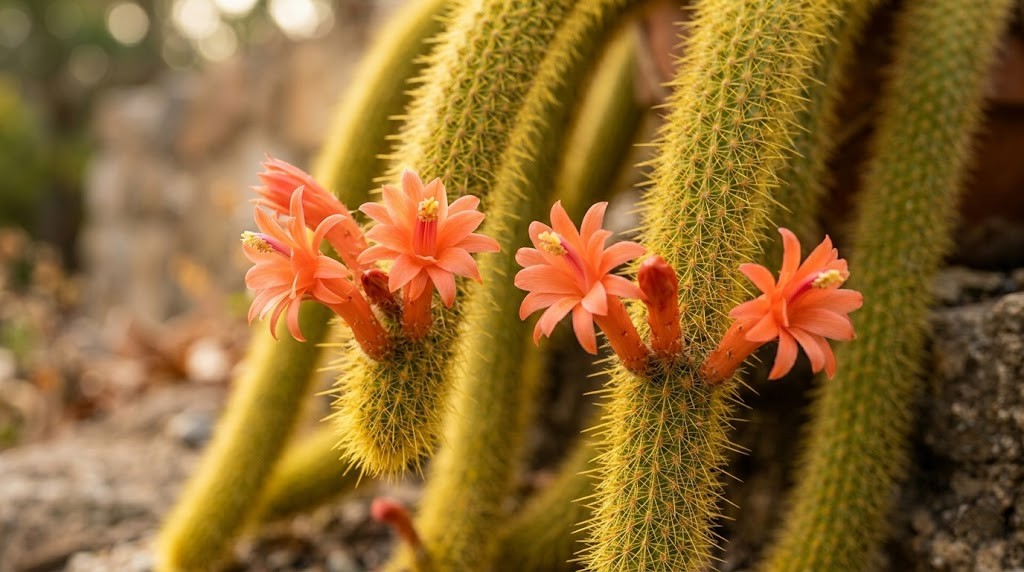
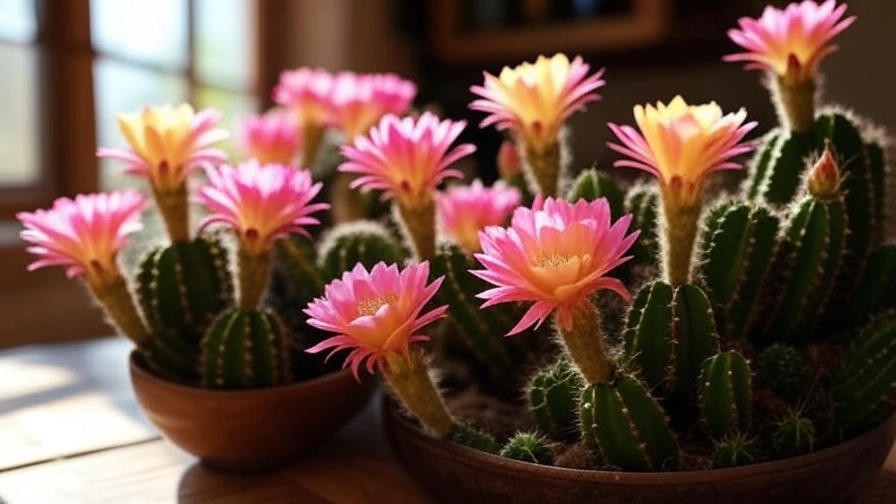
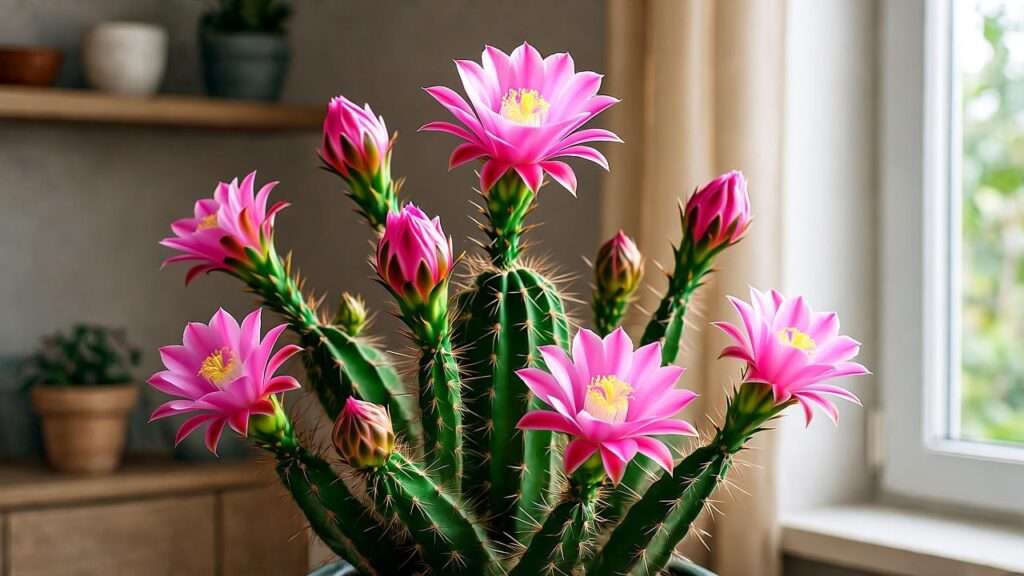
One of the most spectacular rewards of expert cactus care is witnessing a mature Cleistocactus winteri burst into flower. The vivid, multi-petaled salmon-orange blooms open along the lengths of the hanging tails, lasting for several days. However, indoor blooming is a privilege earned by mimicking natural seasonal stressors.
Triggering the Winter Dormancy Cycle
A golden rat tail cactus kept in uniform, warm, well-watered indoor conditions year-round will rarely, if ever, produce flowers. The plant requires a physiological trigger to initiate bud development, which comes in the form of a cold, dry winter dormancy.
Step-by-Step Dormancy Protocols
To set your plant up for a stunning spring bloom display, implement the following checklist starting in late November:
-
Lower the Temperature: Relocate the hanging basket to a cooler room in your house, an enclosed porch that doesn’t freeze, or closer to a chilly window glass pane. The target temperature should consistently remain between 50°F and 55°F (10°C–13°C) during the night.
-
Halt the Watering: Stop routine watering completely. Only provide a tiny splash of water if you notice the main stems starting to look distinctly puckered or severely deflated. The dry substrate tells the plant to stop vegetative growth and start forming flower cells internally.
-
Maximize Light Expose: Keep the plant in the brightest spot available. Cold and bright are the magic combinations.
-
Spring Awakening: In late March, as natural day lengths increase, gradually move the plant back into warmer temperatures and slowly resume normal watering. Within a few weeks, small, fuzzy nubs should begin to emerge from the areoles along the stems, which will rapidly swell into magnificent tubular buds.
Step-by-Step Propagation Guide: Multiplying Your Collection
If you want to share this stunning plant with friends or expand your own indoor jungle, propagating the golden rat tail cactus via stem cuttings is exceptionally straightforward and boasts a very high success rate when executed cleanly.
The Stem Cutting Method
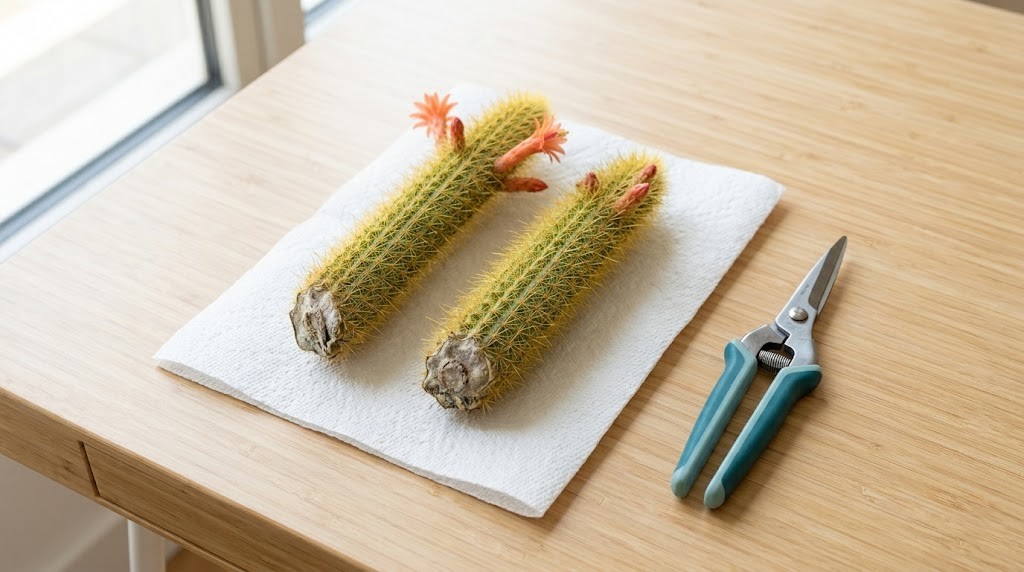
The best time to take cuttings is in late spring or early summer, when the parent plant’s metabolism is firing on all cylinders.
-
Step 1: The Cut: Choose a healthy, plump, actively growing tail. Using a razor-sharp knife or pruning shears that have been thoroughly wiped down with isopropyl alcohol, make a clean, swift cut straight across the stem. Aim for a cutting that is at least 4 to 6 inches long.
-
Step 2: The Callus Period: This is the most crucial step. Never stick a freshly cut cactus piece directly into moist soil. If you do, bacteria and fungi will invade the open wound, causing it to rot within days. Place your cutting in a warm, dry, shaded spot on a clean piece of paper towel. Let it sit undisturbed for 3 to 7 days until the wet cut end dries out completely, hardens, and forms a light-colored, leathery skin called a callus.
-
Step 3: Potting and Grounding: Once the callus has successfully formed, prepare a small pot filled with your custom, highly gritty mineral mix. Insert the callused end about 1 inch deep into the dry soil. You can use small rocks or chopsticks to prop the cutting upright if it feels top-heavy.
-
Step 4: The Waiting Game: Keep the potted cutting in a bright room with indirect sunlight. Do not water it. Because the cutting has no roots, it cannot absorb water; moisture in the soil will only trigger rot. Instead, leave it completely dry for 3 to 4 weeks. During this time, the cutting will utilize its stored water reserves to push out fresh, opportunistic roots from the base. Gently tug on the cutting after a month—if you feel resistance, roots have anchored, and you can begin watering lightly.
Potting, Repotting, and Safe Handling Techniques
Repotting a plant covered in thousands of fine, needle-like spines can feel like navigating a minefield. However, with the right strategy, you can protect both your hands and the plant’s delicate root system.
Choosing the Right Container: Clay vs. Plastic
The type of container you choose directly dictates how your soil behaves.
-
Unglazed Terracotta Pots: These are highly recommended for beginners. The porous clay breathes, allowing moisture to evaporate through the container walls, which helps dry the soil faster. However, because Cleistocactus winteri looks best as a trailing plant, a heavy clay pot requires robust hanging hardware.
-
Plastic Hanging Baskets: Standard plastic hanging planters are lightweight and highly practical for suspension from ceilings or curtain rods. However, because plastic traps moisture inside, you must ensure the pot features numerous drainage holes at the base, and you must use an even grittier soil mix to compensate for the lack of pot evaporation.
The “Towel & Tongs” Handling Trick
When it comes time to repot your golden rat tail cactus—which typically needs to occur every 2 to 3 years to refresh compacted soil or accommodate a root-bound plant—do not rely solely on gardening gloves. The fine golden bristles can easily pierce standard fabric and lodge into your skin.
Instead, use the towel and tongs technique:
-
Wrap a thick, folded piece of newspaper or an old terry-cloth towel securely around the main bundle of stems. This acts as a protective sleeve and prevents the spines from snapping or embedding in your hands.
-
For extra precision and leverage, you can use long, clean silicone-tipped kitchen tongs to gently grip the base of the plant when lifting it out of its old container.
-
Loosen the old, exhausted soil from around the root ball using a dull chopstick, inspect for pests, and lower it into its new pot, backfilling with your fresh, dry gritty mix.
-
Pro-Tip: Wait a full 5 to 7 days before watering your newly repotted cactus. This allows any micro-tears in the roots that occurred during the move to heal safely over, preventing soil-borne pathogens from entering.
Troubleshooting Common Problems (Diagnostic Guide)
Even with diligent care, indoor environments can present structural or pest challenges. Use this diagnostic matrix to quickly identify visual symptoms and execute immediate corrective steps.
Frequently Asked Questions (FAQ)
Is the golden rat tail cactus fast-growing?
Yes, compared to many other desert cacti species which can take decades to mature, Cleistocactus winteri is a relatively fast grower under optimal conditions. In a single growing season with ample bright sunlight, correct watering, and proper fertilization, healthy stems can easily put on 6 to 12 inches of new trailing length.
Why is my golden rat tail cactus turning green?
If your golden stems are starting to look distinctly green, it is almost always due to a lack of light. The plant’s golden coloration comes from the sheer density of its bright yellow spines. When light levels drop, the cactus produces more chlorophyll within its main stem tissues to capture what little light energy is available, and the spines may grow sparser and thinner. Move it to a brighter location to restore its signature gilded luster.
Are the spines dangerous to household pets?
The golden rat tail cactus is listed as non-toxic to both cats and dogs, meaning it contains no poisonous sap or chemical irritants. However, its spines are physically problematic. The thousands of tiny, fine bristles can easily lodge into sensitive paws, noses, and mouths if a curious pet brushes against it. For the safety of your animals and the integrity of your trailing stems, always grow this plant in a high, securely mounted hanging basket well out of reach.
Conclusion
The golden rat tail cactus is an unparalleled masterpiece of the desert world, offering an extraordinary blend of cascading form, radiant color, and stunning seasonal blossoms. By respecting its evolutionary origins—providing it with bright direct sunlight, utilizing an ultra-porous gritty substrate, and respecting its need for a cold, dry winter dormancy—you can easily cultivate a breathtaking specimen that will thrive for decades indoors. Take a moment to evaluate your current window layouts today, choose a high-quality hanging container, and invite the architectural drama of Cleistocactus winteri into your home.